



CEO of a company with two unicorns in its portfolio: “The more unicorns we can call Lithuanian, the better.”
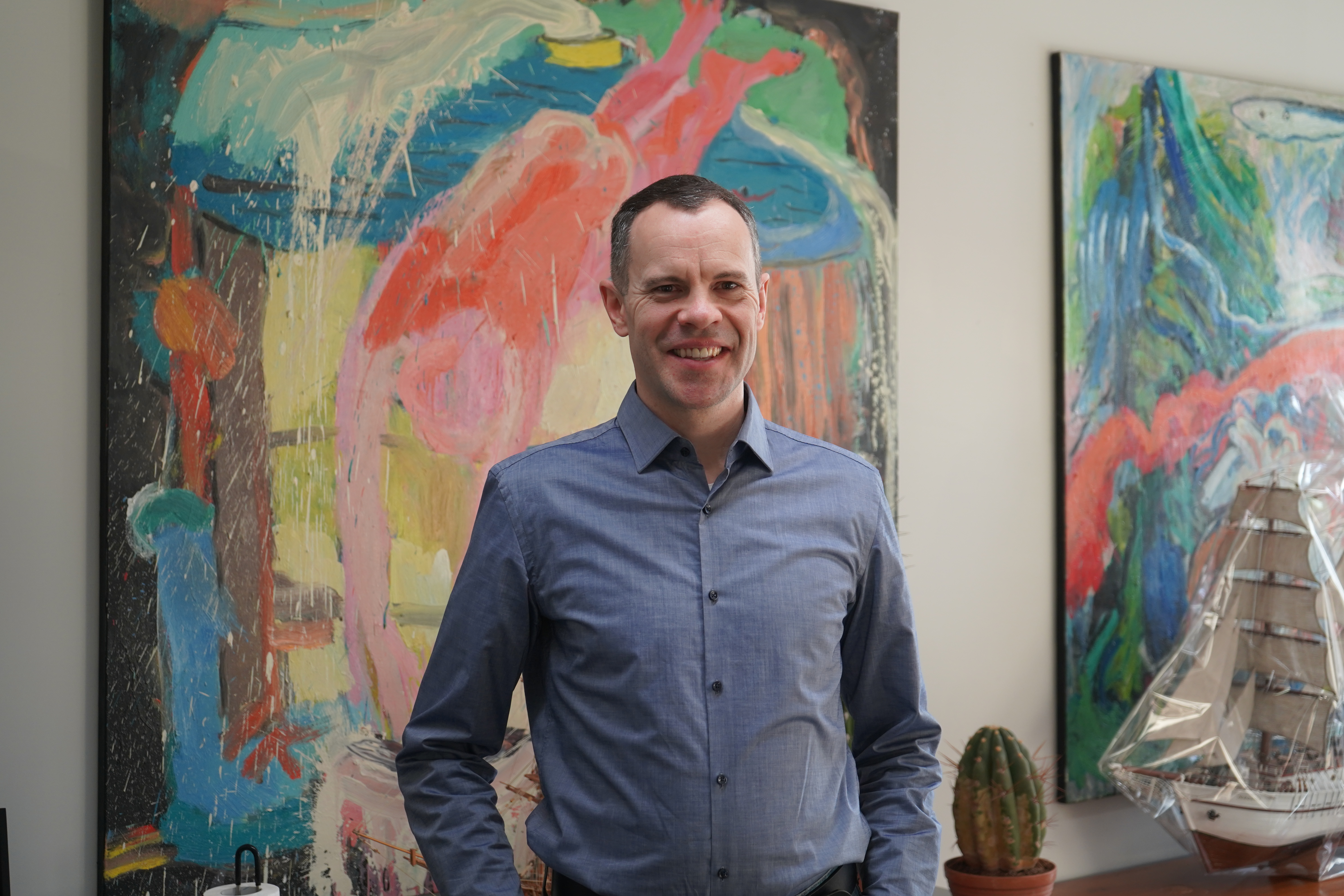
Paulius Insoda, NFQ Technologies (photo by Tech-Park Kaunas)
The “unicorn” status has become a measure of success in the startup ecosystem and even a symbol of national pride. However, while public discourse focuses on startups that have reached billion-dollar valuations, the real processes behind building them often remain behind the scenes. Is it even possible to grow a “pure” Lithuanian unicorn in a small country, completely detached from the global world? From a business perspective, what is more valuable: a prestigious title or a quietly profitable company that consistently generates cash?
We explored these questions together with Paulius Insoda, who offered insights into the behind-the-scenes reality of building and scaling startups and unicorns. He leads NFQ Technologies, one of the most successful Lithuanian international IT companies, which grew out of a startup at Kaunas Science and Technology Park. The company’s portfolio includes globally recognized unicorns such as Kayak and HomeToGo.
In an in-depth and candid interview, Insoda also shares his perspective on what criteria define a “Lithuanian” unicorn, why Lithuania could benefit from adopting Estonia’s bold communication style, and why German perfectionism sometimes loses to American speed.

Paulius Insoda, NFQ Technologies (NFQ photo)
Lithuanian Unicorn Criteria:
– At the beginning of the year, positive news emerged—another Lithuanian unicorn, Cast AI, had joined the ranks. What was your reaction to this news?, – we asked Paulius Insoda.
– I’m very happy. Confirmed success stories are extremely valuable for Lithuania, and we need more of them. They strengthen our reputation and visibility in global markets in a positive context - through achievements, discoveries, inventions, and innovation.
– This success story has once again sparked quite a few reflections and discussions—when can a unicorn be called Lithuanian? Should it be registered in Lithuania, should the idea originate from Lithuanians, or should the key work be carried out in Lithuania?
– First of all, the more unicorns we can call Lithuanian, the better.
Second, there are no official or formal criteria that allow us to tick boxes and say that one unicorn is Lithuanian while another is not - that one meets 87% of the criteria but lacks 13%.
It is very difficult to create a “pure” Lithuanian unicorn that is fully isolated within Lithuania. Most unicorns operate much more broadly - at least across Europe, and often globally - in terms of markets, employees, and investors. If you attract 80% of your capital from outside Lithuania, does that make it a non-Lithuanian startup? What if the leadership team is international?
In principle, what matters is whether, for example, Lithuanians were part of the team, or whether Lithuania exists within the startup’s context - perhaps as its first headquarters or place of registration. Lithuanians may also be the creators of the product, technology, leaders, or key investors. There are many different angles from which a unicorn can be considered Lithuanian.
– So you’re saying that even a hint of “Lithuanian-ness” is enough to call it a Lithuanian unicorn?
– Ultimately, this is more about communication and marketing. The best example is Estonia. Estonians confidently claim how many startups and unicorns they have. You look closer - the company may not be registered in Estonia, the capital may not be Estonian, but there’s still some Estonian “flavor.” Some even say the idea originated in Estonia—and that alone is enough to call it an Estonian unicorn, even if the headquarters and development are based somewhere like New York.
Sometimes people even smile at how everything is labeled Estonian. But they truly know how to leverage these success stories when talking about themselves, and globally they are recognized as a country with a strong digital identity.
– How could Lithuania benefit more from its own success stories?
– When approaching potential business partners or investors in Western Europe, America, or Asia, you can present two different messages.
The first: we are from Lithuania - a country that has achieved a lot, created innovations, and accumulated valuable experience, and we can create something meaningful together with you.
The second message: we are from a small, relatively unknown country, which is why everything is cheaper here, so let’s work together.
Which message carries more weight and greater potential for success? That is the key question.

NFQ Technologies Kaunas (NFQ photo)
From an Idea in Kaunas to the Frankfurt Stock Exchange
– Kayak, HomeToGo—unicorns in NFQ Technologies’s portfolio. Do you consider them Lithuanian?
– We couldn’t say they are purely Lithuanian, but yes - they definitely have Lithuanian DNA.
We can start with the story of Swoodoo (one of the most popular travel search platforms in Europe), which was created from A to Z in NFQ’s Kaunas office. Later, it was acquired by Kayak, and we continued working together for more than 10 years until another exit, when we sold the team working on the project.
Together with Kayak, we went from the stage where it was a relatively small startup to becoming a strong, large unicorn. Even today, one of the most significant product development teams is based in Lithuania. From a technology development and quality culture perspective, Kayak carries a lot of Lithuanian DNA.
HomeToGo launched in 2014. We used all the experience we had gained from Swoodoo and other startup projects. We also learned a great deal from Americans while working on Kayak. As a result, HomeToGo grew significantly faster than Swoodoo—not only reaching unicorn status but also taking a strategic IPO step onto the Frankfurt Stock Exchange and becoming a public company.

– Can you share more similar stories?
– Of course, we have more stories that may be less well known. For example, Alaiko - another large and successful startup - had all its technology developed in Lithuania. Two years ago, it exited through a merger.
I would say we often overlook companies that are so successful they simply raised an initial investment round and then grew profitably on their own - for example, Omnisend. These startups are harder to notice because they never received an official “status” or became unicorns, as they quickly grew and became profitable without external capital.
In other words, we have many more “unicorns” that may not have crossed the billion-dollar valuation threshold but have become large and successful businesses. This raises the question—what is more valuable: a unicorn that “burns” money with the hope of becoming profitable in the future, or a non-unicorn that quietly “prints” money without the label?
German Perfectionism vs. American Speed
– You mentioned differences between U.S. and European startup culture. What would you highlight as the key distinctions?
– If we look at NFQ’s origins, we have a strong German influence in our DNA: very high quality standards and a fair amount of perfectionism. However, when working with Americans, we noticed that this German DNA sometimes goes too far in technical perfectionism, sacrificing the speed required for business.
In the U.S., it’s almost the opposite: very few people care deeply about technical quality. What matters is business performance - growth rate, sales, and traffic.
Interestingly, the German-Lithuanian Swoodoo and the American Kayak started at the same time. After three to four years, Kayak was probably ten times more valuable as a business, even though Swoodoo’s technical quality was light-years ahead. This may have been one of the reasons why Kayak acquired Swoodoo.
In general, it can be difficult for developers to shift their mindset - to understand that systems and code are just tools to enable users, automate processes, and empower business, not an end goal in themselves.
– Our Baltic neighbors, the Estonians, have a strong PR instinct. What can we learn from them?
– Estonians truly master communication, and they are a great example. However, effective marketing is not about constantly pouring money into advertising. The most effective approach is to create a “peak” moment - a wow effect that triggers strong emotions and stays in people’s memory. We have such strong messages - we just need to recognize them, package them properly, and present them effectively.
This brings us to a key observation: why do we often build startups with partners from outside Lithuania? Because technologically we are very strong, but we lack deep traditions in management, marketing, and sales. Compared to Americans, Brits, or Israelis, we are still weaker in this area—they are better at presenting visions, future value, and convincing investors to provide significantly larger investments and valuations.
Of course, a big part of this also comes down to our country’s image and reputation. Estonia finds it easier to attract serious capital than Lithuania. I have heard investors say things like: “Estonia is such a small country, yet it creates so many unicorns - we should jump on that train as well.”
Perhaps this is due to our natural modesty or other cultural factors, but one way or another, reputation and image are far more important than we sometimes think - and they have a long-term effect.
It is important to understand your strengths and weaknesses. You need to leverage your strengths and find the right partners to compensate for your weaknesses. Only then can you build a truly strong team.
NFQ Technologies (NFQ photo)